Out December 2 · The companion to Adventure Finance

Brave New Capital: The Pioneers Rewriting the Rules of Finance

The rules of finance aren't laws of nature. They are choices.

Meet the pioneers who are choosing to shift power, share ownership, and rewrite the rules of finance.

With a foreword by Kate Raworth, author of Doughnut Economics

1,700+ copies pre-ordered

Brave New Capital publishes on December 2.

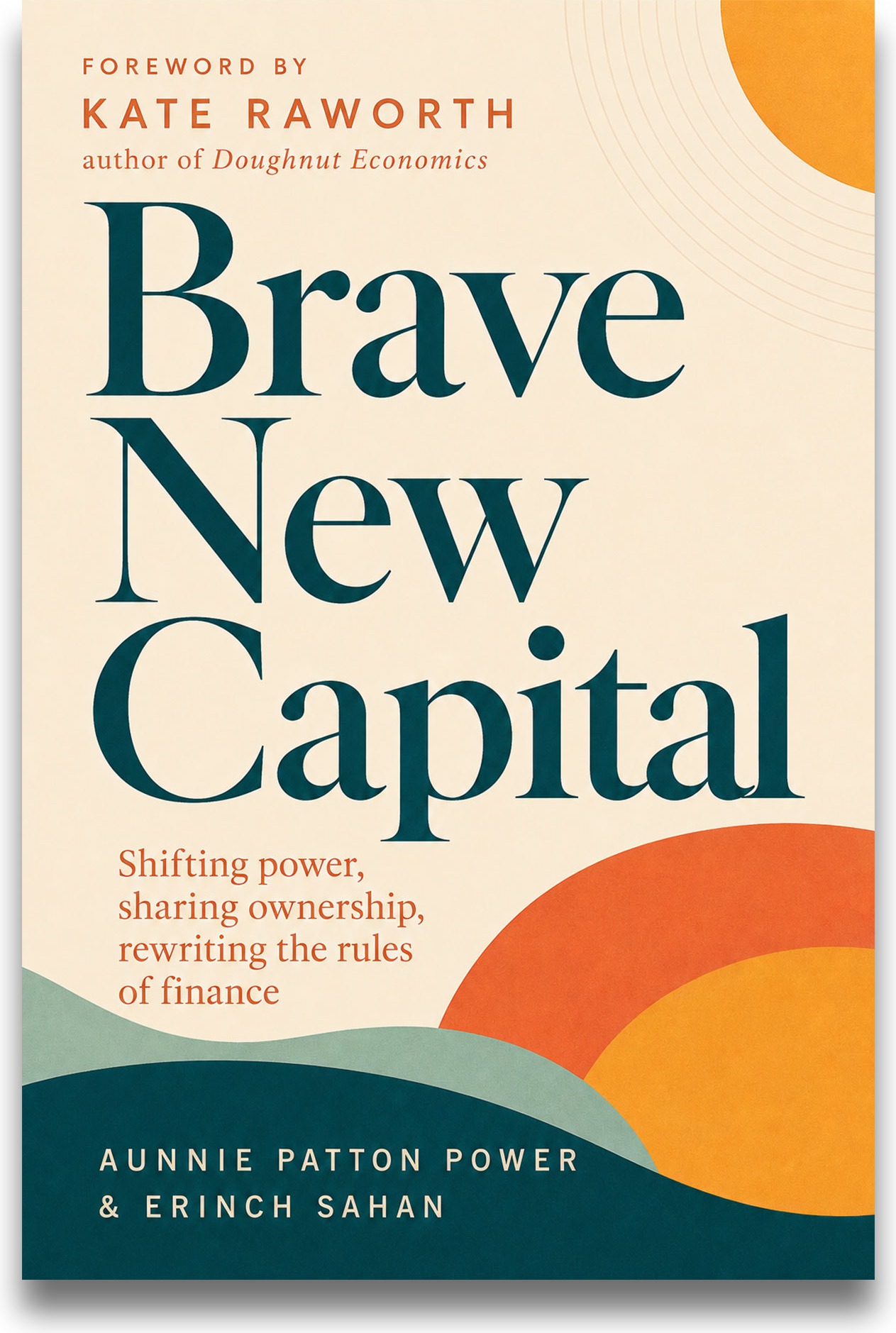
Cover of Brave New Capital: The Pioneers Rewriting the Rules of Finance, by Aunnie Patton Power and Erinch Sahan, foreword by Kate Raworth

People designed this system, which means we can redesign it.

In Barking and Dagenham, a borough in East London, 12 residents met every month for a year. Their assignment? Write the investment policy for their community's endowment. Today, their policy guides how that endowment is invested.

There has never been more money trying to fix the world, yet the problems seem to keep getting harder. The money is real, and so are the intentions. What hasn't changed is the machinery: most funds are still built to concentrate wealth, ownership, and power with the people who already have them.

Brave New Capital is about the people who are rewriting the story of impact investing. Across the globe, a generation of pioneers looked at the machine they'd inherited, understood it completely, and chose to build something else: indigenous-led outcomes funds, steward-owned management companies, neighbourhoods that own the housing they live in, funds with no carried interest or end date at all.

This is not a book of theory or critique. It's a field guide to what these pioneers actually built: how they redesigned ownership, power, structure, and incentives, what it cost them, and what becomes possible when capital is designed around the people closest to the problem.

The rules of finance were never laws of nature. They were design choices. These are the stories of people who have chosen to design differently. And this book is an invitation to join them in redesigning finance.

What's inside

Stories from the Frontier of Fit-for-Purpose

Brave New Capital takes you inside the work of pioneers who are rebuilding finance one vehicle at a time. Here is a sneak peek of some of the stories:

A fund that buys companies from retiring owners and hands them to the workers who built them.

Ownership

A neighbourhood that owns the housing its residents live in, and decides for itself what success looks like.

Ownership

A citizens' fund where hundreds of ordinary people vote on every investment. One person, one vote. No carried interest.

Power

An Indigenous-led fund where an elder assesses every deal across seven generations: three back, three forward.

Power

A fund owned entirely by a perpetual purpose trust, designed so its mission can never be sold.

Structure

A fund manager who eliminated carried interest, asking: instead of making fund managers into millionaires, could we redirect value towards deeper impact?

Incentives

These six are just the opening. Inside, you'll explore the personal stories of twenty fund managers across six continents and more than a dozen countries. The book is organised into four sections, each highlighting a key theme.

Core Themes
i

Ownership

Who holds it, and who's been kept from it. Employees, communities, nonprofits, and stewards, each redesigning who profits from what capital builds.

ii

Power

Who decides, and who defines what good looks like. From citizens voting on every deal to communities setting the terms of their own success.

iii

Structure

The vehicle itself, redesigned from the ground up. Permanent capital, ecosystem funds, and vehicles built for the markets the templates forgot.

iv

Incentives

Who gets paid, for what, and why. From carry sent to a nonprofit to managers who removed their own carry altogether.

Inside the book

A story-led book, not an academic one.

The stories are about who the pioneers are and where they came from, which gives us the foundation to talk about what they built, why they built it, what it cost them, and what became possible. The ideas arrive through the stories.

The book is also made to be used. Every story shows the design choices the pioneers made, so the ideas don't just inspire, they travel.

What you'll walk away with

  • The defaults of finance seen clearly as the choices they are, not the laws they pretend to be.
  • A menu of ownership, power, structure, and incentive designs that real funds have already tested.
  • Sharper questions to ask of any fund you build, join, or back.
An excerpt from the book

In 2018 Todd picked up the phone to call Phil. He had been chewing on the idea for an employee ownership fund for several years, and finally felt that it was the time. He wanted to walk Phil through his idea and brainstorm, but he didn't get the chance. When Todd started talking about employee ownership, Phil interrupted him, saying: 'Man, we need to start a fund.'

Phil had been about to make a move of his own. He was planning to raise money and buy a small business to run himself. 'I knew being the owner was the way,' he says. As Todd talked, it clicked. With his private equity background, Phil didn't see a complicated transaction. 'To me, it just reads like an LBO,' he remembers, 'but instead of selling to some unknown buyer, you're selling to the employees.'

That's the sentence that launched Apis & Heritage by reframing an old idea into a new one. The same mechanics that private equity uses to concentrate wealth could be redirected to distribute it.

From the chapter on Apis & Heritage, in the Ownership section.
Who it's for

This book is for you if you…

Wherever you sit in relation to capital, there's a way into this book.

Build the vehicles.

A fund manager or GP who suspects the standard structure doesn't fit the work. You'll find a menu of designs others have already built and tested, and an honest account of what each one cost.

Fund them.

A foundation, family office, DFI, or LP. You'll meet the people on the other side of the table who said yes, and see what it looks like to fund what's genuinely built around need.

Raise the capital.

A founder who's tired of bending the business to fit the money. You'll find models of capital designed around the enterprise instead, and language for what to ask of your investors.

Work in impact or development finance.

And have felt that nagging sense that the fund doesn't fit the mission. This names it, and shows you who's already solved it.

Shape the rules.

A policymaker, regulator, or ecosystem builder. You'll see which constraints are real and which are just habits.

Are rethinking capitalism.

No finance background required. The stories carry the ideas, and the ideas reach well past finance, into ownership, democracy, and who the economy is really for.

Why it matters

How far this book travels is up to you.

Every pre-order was a vote: it told us, and the wider field, that there's real hunger for this.

Aunnie has been working on this book for over four years. Erinch joined just over a year ago. The book publishes on December 2, and our pre-order readers are what made that possible.

The pre-sale showed us how much appetite there is, and it helps fund the print run itself. Thank you to everyone who pre-ordered.

We're doing this to drive the kind of change we describe. Profits go into building the ecosystem these chapters describe, supporting the pioneers and communities redesigning capital from the inside out.

Publishing December 2

Out on December 2.

Thank you to everyone who pre-ordered. Brave New Capital publishes on December 2. Leave your email below and we'll let you know the moment it is published and available for sale.

Get notified when it's published

Leave your email and we'll tell you when the book is out and ready to buy.

The foreword

A foreword by Kate Raworth

We're honoured that Kate Raworth, economist and author of the international bestseller Doughnut Economics, has written the foreword to Brave New Capital. Her work has reshaped how a generation thinks about what an economy is for. This book takes up that question where capital meets the people closest to the problem.

The authors

Aunnie Patton Power in

Author of Adventure Finance · Founding Director, IFI

A reformed M&A banker who got out, moved to India to figure out what impact investing was all about, and has spent the fifteen years since trying to redesign how capital actually works. She's worked across five continents with funds, foundations, governments, and family offices. Her first book, Adventure Finance, has been read by tens of thousands and translated into four languages. That one was about the instruments of innovative finance. Brave New Capital is about the vehicles that house them, the thing she's been (not so quietly) obsessed with ever since.

Erinch Sahan in

Joseph Rowntree Foundation · ex-Doughnut Economics Action Lab

Has spent two decades redesigning business and finance from the inside, across companies, NGOs, and government, on four continents. He now invests a multi-hundred-million-pound endowment at the Joseph Rowntree Foundation toward a more just and equitable future. He has spent his career arguing that businesses and the capital behind them have to be redesigned together.

There's a brave new world of capital worth reading about.

Sign up to hear when it's published. Tell a friend. Help us show there's real hunger for a different conversation about capital.

Get notified at launch