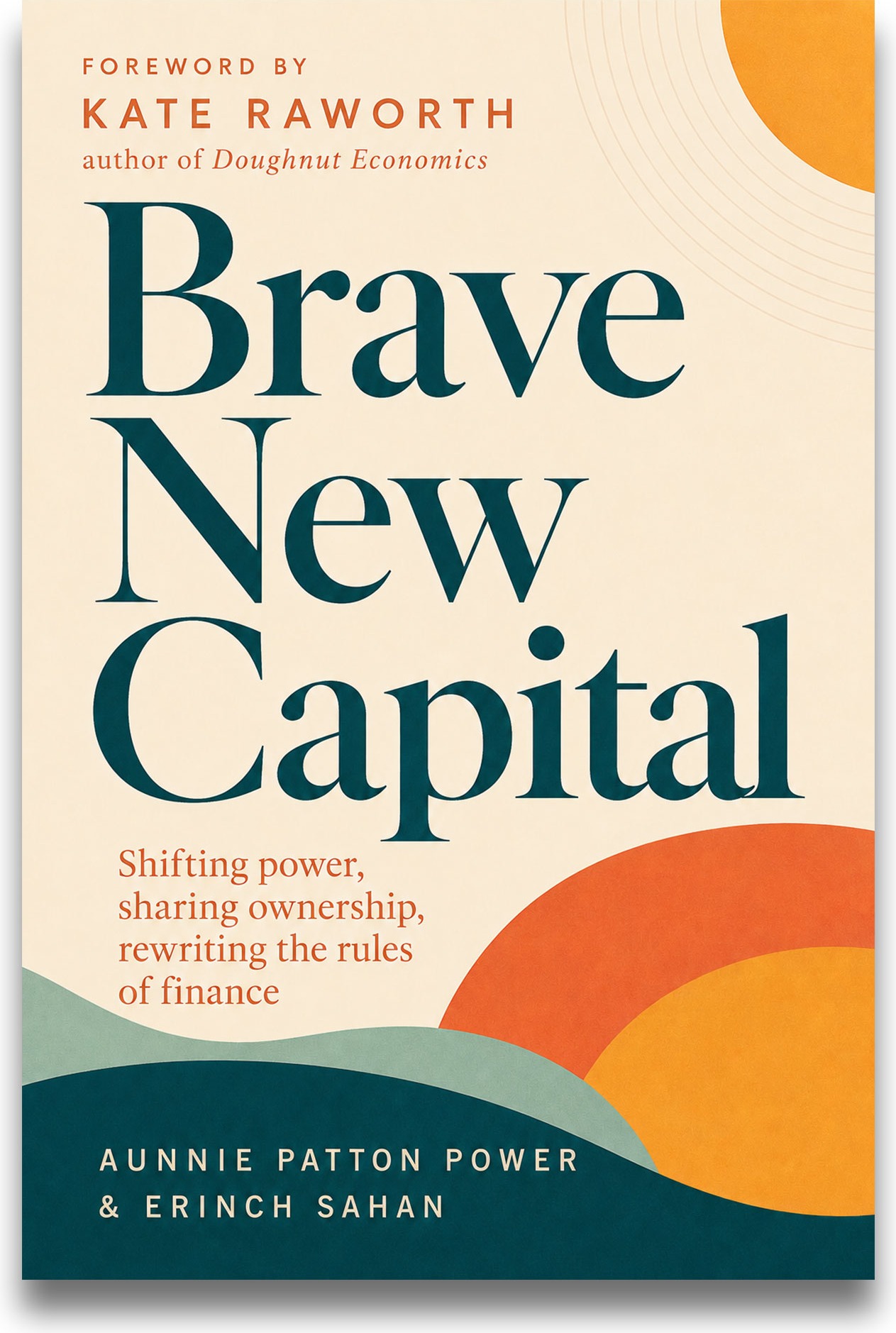
Meet the pioneers who are choosing to shift power, share ownership, and rewrite the rules of finance.
With a foreword by Kate Raworth, author of Doughnut Economics
It isn't enough to change the mission statement on the cover page of finance. We need to rewrite the story underneath.
If you've spent time in impact investing, you've felt it. That nagging feeling that something isn't quite right. The intentions are real, the capital is flowing, and yet the funds we've built to deploy it look almost identical to the ones designed decades ago for entirely different purposes.
Brave New Capital is about the people who are rewriting the story of impact investing. Across the globe, a generation of pioneers looked at the machine they'd inherited, understood it completely, and chose to build something else: indigenous-led outcomes funds, steward-owned management companies, neighbourhoods that own the housing they live in, funds with no carried interest or end date at all.
This is not a book of theory or critique. It's a field guide to what these pioneers actually built: how they redesigned ownership, power, structure, and incentives, what it cost them, and what becomes possible when capital is designed around the people closest to the problem.
The rules of finance were never laws of nature. They were design choices. These are the stories of people who have chosen to design differently. And this book is an invitation to join them in redesigning finance.
Brave New Capital takes you inside the work of pioneers who are rebuilding finance one vehicle at a time. Here is a sneak peek of some of the stories:
A fund that buys companies from retiring owners and hands them to the workers who built them.
A neighbourhood that owns the housing its residents live in, and decides for itself what success looks like.
A citizens' fund where hundreds of ordinary people vote on every investment. One person, one vote. No carried interest.
An Indigenous-led fund where an elder assesses every deal across seven generations: three back, three forward.
A fund owned entirely by a perpetual purpose trust, designed so its mission can never be sold.
A fund manager who eliminated carried interest, asking: instead of making fund managers into millionaires, could we redirect value towards deeper impact?
These six are just the opening. Inside, you'll explore the personal stories of twenty fund managers across six continents and more than a dozen countries. The book is organised into four sections, each highlighting a key theme.
Who holds it, and who's been kept from it. Employees, communities, nonprofits, and stewards, each redesigning who profits from what capital builds.
Who decides, and who defines what good looks like. From citizens voting on every deal to communities setting the terms of their own success.
The vehicle itself, redesigned from the ground up. Permanent capital, ecosystem funds, and vehicles built for the markets the templates forgot.
Who gets paid, for what, and why. From carry sent to a nonprofit to managers who removed their own carry altogether.
The stories are about who the pioneers are and where they came from, which gives us the foundation to talk about what they built, why they built it, what it cost them, and what became possible. The ideas arrive through the stories.
The book is also made to be used. Every chapter closes with the design lever taken apart, and a "What Would It Take?" section, so the ideas don't just inspire, they travel.
In 2018, Todd Leverette reached out to his college buddy Phil Reeves. He was excited to brainstorm with him around what it would take to start a fund for employee ownership. He'd been circling the idea for years, but he finally felt like now was the time.
He picked up the phone planning to walk Phil through the idea from the beginning. He didn't get the chance. Before Todd could deep dive into ESOPs or racial wealth building or fund structures, Phil interrupted him with "Man, we need to start a fund."
Phil had been on his own journey working with small businesses in DC. He had seen the entrepreneurship-through-acquisition space open up and he knew that ownership was the path, but he didn't yet have a vehicle. When Todd started talking about employee ownership, Phil's private equity training snapped into focus and the fund idea emerged spontaneously. He stripped the complexity away in a single sentence: "This is a leveraged buyout, but instead of selling to some unknown buyer, you're selling to the employees."
That's the sentence that built Apis & Heritage. It reframed an old idea into a new one. The same mechanics that private equity uses to concentrate wealth, redirected to distribute it. It certainly wasn't going to be easy, but these two friends from college felt this was their calling and were willing to throw 150% of themselves into making this a reality.
Wherever you sit in relation to capital, there's a way into this book.
A fund manager or GP who suspects the standard structure doesn't fit the work. You'll find a menu of designs others have already built and tested, and an honest account of what each one cost.
A foundation, family office, DFI, or LP. You'll meet the people on the other side of the table who said yes, and see what it looks like to fund what's genuinely built around need.
A founder who's tired of bending the business to fit the money. You'll find models of capital designed around the enterprise instead, and language for what to ask of your investors.
And have felt that nagging sense that the fund doesn't fit the mission. This names it, and shows you who's already solved it.
A policymaker, regulator, or ecosystem builder. You'll see which constraints are real and which are just habits.
No finance background required. The stories carry the ideas, and the ideas reach well past finance, into ownership, democracy, and who the economy is really for.
Every pre-order is a vote: it tells us, and the wider field, that there's real hunger for this.
Aunnie has been working on this book for over four years. Erinch joined just over a year ago. We're nearly ready to send it out into the world, but we haven't decided how.
This pre-sale is how we find out how much appetite there is. Strong demand opens doors: it's what we'd take to a publisher to win the kind of reach usually reserved for the few. Quieter demand, and we publish it ourselves. Either way, your copy is guaranteed and either way, we're keeping it affordable and accessible.
We're doing this to drive the kind of change we describe. Profits go into building the ecosystem these chapters describe, supporting the pioneers and communities redesigning capital from the inside out.
Every copy helps decide how far this book travels, and keeps it affordable for everyone who wants to read it.
Pre-ordering now reserves your copy and helps us prove the demand. We'll email you the moment it's ready.
Leave your email and we'll let you know the moment Brave New Capital is out.
Pre-order one. Tell a friend. Help us prove there's real hunger for a different conversation about capital.
Pre-order your copy